20 Years Later, 'Amazing Grace' Producer Says William Wilberforce's Story Still Resonates
Michael Foust

Audio By Carbonatix
By Michael Foust, Crosswalk.com
Two decades after "Amazing Grace" brought William Wilberforce’s remarkable story to the big screen, the producer who helped make it is hoping a new generation will be inspired by the man who helped lead the fight to abolish slavery in the United Kingdom.
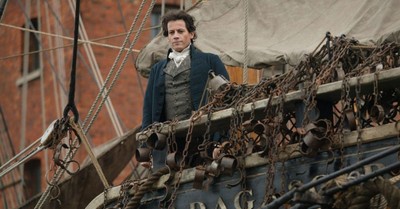
Amazing Grace is enjoying a 20th-anniversary re-release this year, streaming on Angel through Oct. 31 and available to purchase or rent on all major platforms. A newly released 20th-anniversary DVD has also hit shelves. The film follows Wilberforce’s decades-long campaign to end the British slave trade and the role his Christian faith played in his historic crusade.
It starred Ioan Gruffudd ("Fantastic Four") as Wilberforce, Benedict Cumberbatch ("Doctor Strange") as his close friend and ally, Prime Minister William Pitt, and Albert Finney ("Murder on the Orient Express") as John Newton, the author of the beloved hymn "Amazing Grace."
Bob Beltz, a co-producer who helped champion the story before its 2006 release, calls Wilberforce “one of the most incredible human beings” in world history.
“It was said that he made doing good fashionable,” Beltz told Crosswalk Headlines.
Wilberforce (1759-1833) famously championed efforts to abolish the slave trade in Parliament year after year, beginning with his first bill in 1791, which was defeated 163–88, before the cause finally prevailed 16 years later in 1807, when the House of Commons approved a bill banning the slave trade, 283–16.
He then turned his attention to abolishing slavery itself and saw Parliament pass such a bill in 1833, just three days before his death.
“One of the underlying messages of the film is persistence and perseverance,” Beltz said, noting that the film opens with Wilberforce on the verge of a nervous breakdown, worn down by repeated failures to advance abolition and with little reason to believe the future would be any brighter.
In 1796, Wilberforce “believed that he had the votes” – only to see his opponents distribute free opera tickets to members of Parliament who supported Wilberforce’s bill. The performance coincided with a critical vote, and with several supporters absent, Wilberforce’s bill fell just four votes short, 74–70.
“It really got to him,” Beltz said. “... He was at the point of giving up, but was really encouraged to get back into the fight. But it was another 10 years before, finally in 1807, Parliament passed the bill that abolished the slave trade throughout the British Empire.”
Wilberforce was driven by his faith in Christ.
“That was at the heart of everything he did.”
In fact, at one point in his life, Wilberforce wrestled with whether his Christian faith was compatible with a life in politics. Friends and advisers encouraged him to remain in public life and serve God through his work in Parliament.
“Part of what we're hopeful,” Beltz said, “is that this story will connect with a new generation, particularly of faith.”
Photo Credit: ©WaldenMedia
Michael Foust has covered the intersection of faith and news for 20 years. His stories have appeared in Baptist Press, Christianity Today, The Christian Post, the Leaf-Chronicle, the Toronto Star and the Knoxville News-Sentinel.
Listen to Michael's Podcast! He is the host of Crosswalk Talk, a podcast where he talks with Christian movie stars, musicians, directors, and more. Hear how famous Christian figures keep their faith a priority in Hollywood and discover the best Christian movies, books, television, and other entertainment. You can find Crosswalk Talk on LifeAudio.com, or subscribe on Apple or Spotify so you never miss an interview that will be sure to encourage your faith.


