A Charge to a Man of God (Part 1 of 3)
Ministries > Truth For Life with Alistair Begg
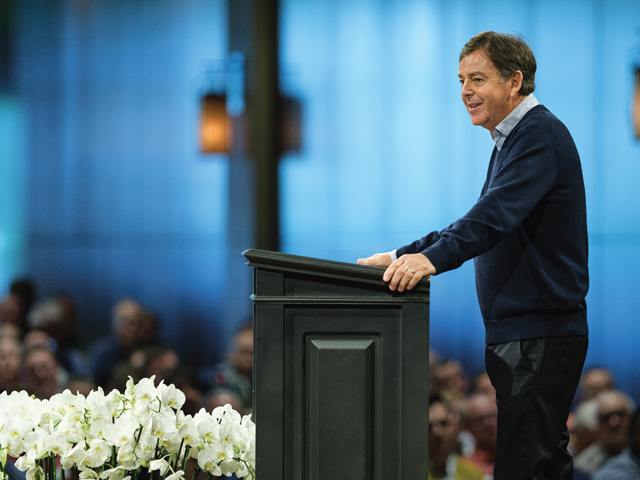
 Are you growing in faith? You’ve probably heard the saying, “As goes the shepherd, so go the sheep.” Listen to Truth For Life as Alistair Begg examines the role of church leaders in establishing the pattern of spiritual maturity for the whole church.
-----------------------------------------
• Click here and look for "FROM THE SERMON" to stream or read the full message.
• This program is part of the series A Study in 1 Timothy, Volume 2’
• Learn more about our current resource, request your copy with a donation of any amount.
• In one of the most famous sermons ever preached, Jesus explains that the values in His kingdom are vastly different from the world’s values! The poor will be blessed, those who weep shall laugh, and the hungry will be satisfied. What does this mean? Download the free ebook and study guide The Christian Manifesto by Alistair today at ‘truthforlife.org/manifesto’
Helpful Resources
- Learn about God's salvation plan
- Read our most recent articles
- Subscribe to our daily devotional
Follow Us
YouTube | Instagram | Facebook | X
This listener-funded program features the clear, relevant Bible teaching of Alistair Begg. Today’s program and nearly 3,000 messages can be streamed and shared for free at tfl.org thanks to the generous giving from monthly donors called Truthpartners. Learn more about this Gospel-sharing team or become one today. Thanks for listening to Truth For Life!
Guest (Male): Are you growing steadily in your faith? Alistair Begg often says as goes the shepherd, so go the sheep. And today on Truth for Life, we'll look at the Apostle Paul's instruction to his young protege Timothy to find out how church leaders established the pattern of spiritual maturity for the whole church.
Alistair Begg: Our scripture reading is found in 1 Timothy chapter 6 beginning at the 11th verse. 1 Timothy chapter 6 and verse 11. But you, man of God, flee from all this and pursue righteousness, godliness, faith, love, endurance, and gentleness. Fight the good fight of the faith. Take hold of the eternal life to which you were called when you made your good confession in the presence of many witnesses. In the sight of God who gives life to everything and of Christ Jesus who while testifying before Pontius Pilate made the good confession, I charge you to keep this command without spot or blame until the appearing of our Lord Jesus Christ, which God will bring about in his own time. God, the blessed and only ruler, the King of Kings and Lord of Lords, who alone is immortal and who lives in unapproachable light, whom no one has seen or can see. To him be honor and might forever. Amen. Let's pause in a moment of prayer. Make the book live to me, oh Lord. Show me yourself within your word. Show me myself and show me my savior. And make the book live to me for Jesus' sake. Amen. Do not be like them. That was Jesus' statement to his disciples in the sermon on the mount when he encouraged them to be radically different from those who were their pagan neighbors. These individuals were concerned about all kinds of things on a very natural level. And Jesus said to his disciples, if you're going to follow me and if you're going to declare your trust in me, then do not be like them. Now that simple phrase could so easily have been taken up and employed by Paul as he comes to this particular point in his exhortation of Timothy because he has been pointing out to Timothy and to Timothy's readers the fact that the false teachers who had made such an impact in the community in which Timothy was ministering were themselves involved in fruitless squabbles. They were greedy, double-talking troublemakers. And it was imperative that if Timothy's ministry was going to have the kind of impact that God intended, then Timothy mustn't be like these folks, individuals who by their very lifestyle had indicated the fact that they saw ministry and godliness as a means to financial gain. And between verse 3 and verse 10 of chapter 6, although not for the first time, Paul is pointing out the vices of these individuals. And as he begins the 11th verse, he does so in a very decisive way, making sure that Timothy understands that while these other characters have made a career out of vice that it is to be a commitment to virtue which marks Timothy's life and ministry. Now in my notes, I simply proceeded down through these early verses with two phrases in mind. The first of which is this. Look at how he describes him. And the second is consider how he directs him. And so that's the framework in which we're going to pursue a line through these verses. Look at the way in which Paul describes Timothy in a phrase, man of God. But you, man of God. It is a striking phrase. If you pause for just a moment and say to yourself, I wonder why he would refer to him in this way. He could have said my fellow soldier. He could have said as he does other places, my son in the faith. He could have encouraged him as a colleague at arms as it were. But he chooses purposefully, obviously to use what is a very striking phrase. But you, unlike these other individuals to whom we may refer as men of gold in so far as they were so interested in possessions represented by gold, he says Timothy, you're not a man of gold. You are a man of God. Now it is this point of identity which builds the foundation for all of the exhortations that follow. What Timothy is or if you like who Timothy is determines his principles and his practice. And despite the fact that in our present time that notion has fallen on hard times in relationship to public acceptance in so far as it is customary to assume that what a man is in private is somehow isolated from his activities in public. The New Testament knows nothing of such a distinction. Rather it says it is the very character of the individual, the identity of the individual which gives foundation and explanation to the principles by which he makes decisions and to the practice of his life. Now this comes out in all kinds of ways in our daily routine. And there is a wonderful story told by Singer Ferguson in one of his books. He describes a scene where a gentleman, an elderly gentleman in England is walking down the street of one of the cities in England. And as he walks along the pavement, he sees a young man coming towards him. And he is struck by the deportment of the young man. And so as the young fellow reaches him and is alongside him, the elderly gentleman simply turns his head and says to him, what is the chief end of man? And the young fellow walked two further steps beyond him and he turned around and he said, sir, the chief end of man is to glorify God and to enjoy him forever. And the elderly gentleman said, I could see that you were a Westminster confession man. His very deportment, the way in which he carried himself had an aura about it, had an an air about it. And it was his identity that gave the basis to his deportment. And that is true of every one of us. It is the youngster's identity that is revealed in his clothing and in her clothing. They may seek to find an identity in the way they dress, but in actual fact that identity is simply mirrored in the way they dress unless of course they're dressing up for some pageant or another. We give testimony to the identity by the principles and practices of our lives. And so he says to Timothy, I'm addressing you as a man of God, which was a staggering statement because man of God was one of the most striking titles that was contained in all of Old Testament scripture. Moses is referred to as a man of God in Joshua 14. Samuel is a man of God. Elijah is a man of God. Elisha is a man of God. David is a man of God. So can you imagine receiving a letter from your commander in chief as it were? And as you unroll the scroll and you're reading about these false teachers and their commitment to worldly gain and stuff and then you turn the scroll over just a little and it says but but you, man of God. Do you like that designation? Do you fit that designation? You see each of the Old Testament individuals so described had been entrusted with a high office and Timothy had been entrusted with a high office. But the fact is this morning, loved ones, that this designation by the time you read reach the New Testament is a designation not uniquely pertaining to those called to a special office, but is a designation that is generic. For example, if you turn to 2 Timothy chapter 3 and look at verse 16 and 17, you find there the same phrase being used. The scriptures are given as God-breathed, useful for teaching, rebuking, correcting, and training in righteousness so that, notice, the man of God may be thoroughly equipped for every good work. Who to whom does the writer refer? He refers to the believer. It is used in a generic way. Therefore it might equally have been said of of a woman who is in Christ, to the child of God, to the individual who has been redeemed by God's outstretched hand. Says Hendrickson, surely if every Christian is a man of God, Timothy having been placed in a position of great responsibility is this in a special sense. And of course he was. Timothy, man of God. Now this is made all the more striking when we consider the fact that Paul was keenly aware of the fact of Timothy's own limitations. We said in the commencement of this study that there is a realistic sense in which Timothy had more disqualifications than he had qualifications. After all, he was comparatively young. People were talking about his youthfulness. It seemed to be a bit of a hindrance. He was naturally timid. He didn't move amongst people with perfect ease. He was physically frail. And hence he had to make sure that his tummy that was set off by all kinds of things did not debilitate him in ministry. But Paul doesn't write to him and say, now Timothy, I know that you're naturally young, you're physically frail, and you and you're you're timid in that way. That would have been no great encouragement. That would simply have induced despair. We don't need to be reminded of our imperfections. We're aware of those. But what a challenge and what an encouragement by the reminder of his identity. Timothy, you, the man of God, you've received a divine commission. You've been enlisted in God's service. You've been called to God's purpose that you might give God glory. Now if you're a believer here this morning, all of that is true of you. What whatever else may be true of you, whatever you may or I may choose to muster up to put on my resume, whatever I may determine gives me significance in the journey of my life, the fact of the matter is that that the great consequential truth of our lives is in a phrase here. You are a man of God. So if we didn't get up with a spring in our step yesterday or the day before or the day before that because we've been focused on our own imperfections or our own inabilities or our own inconsequential natures, then a simple reminder like this may be a great encouragement. So often the way in which we tend to approach people is the very reverse of this. I've told you before of Mr. McFadyen who was the deputy principal of my primary school in Glasgow. How he was a great bagpipe player and won competitions and blew his bagpipes all over the place. He also blew children all over the place as it turned out. And he had a most acerbic wit. And sometimes there was no wit. It was only acid. And I remember one occasion of which I've told you before where one poor unfortunate soul in the class was told to stand. And Mr. McFadyen told him that instead of having a head on his neck, he had a turnip on his neck. And so he said to him, Wetherspoon, fictitious name, you have a turnip on your neck. And then he said, now Wetherspoon, tell the class what you have on your neck. And so he had to say, class, I have a turnip on my neck. Now somehow or another this was deemed as a great therapeutic tool on the part of the bagpipe player. What it it did was mark the young man's primary school career forever because he became immortalized his turnip head. Courtesy of Mr. McFadyen, the bagpipe blower. Now, man of God. What do you think that would do to Timothy? I can see him squaring his shoulders just a little. I can see him trying to stand up straight, knowing full well that he is young, that he is timid, he is frail, but he is a man of God. Now let me pause here and make a point of application in relationship to identity in general and the identity of a Christian in particular. Men and women today, especially our young people, are tempted to believe that they're nothing other than a combination of chemicals suspended in a solution. And consequently their life is really trivial. It's not that life is ultimately tragic, it is that life is ultimately trivial. And as a result of that, they have no notion of identity. Therefore two such individuals, we want to go and we want to read for example the 139th Psalm. And we want to tell them that they were intricately wrought together in their mother's womb, that they were designed purposefully by God so that they might in their awareness of this truth arise of a morning and say to themselves, I'm not simply a bunch of grown-up jeans. I am God's creation. In this respect I have stature. I'm not junk, readily disposable, essentially irrelevant. I have my own fingerprints. I have my own DNA. I am like nobody else in all of the world. I have value in the fact that God the creator made me. And that somehow in the mystery of his plans moment by moment he makes it possible for me to live. Now what a radical difference that is from the hopeless, helpless wandering through this earthly life of those who have bought an evolutionary hypothesis and who see themselves as totally irrelevant. Now when you add to that the experience of new creation, it is a great wonder because here is the here is what it's like. Let me think in terms that I've used before, but in Scotland there are all of these wonderful castles. Indeed I keep meeting you and you tell me that you your ancestors had a castle. And I'm glad that they did and presumably you're all intermarried because there aren't enough castles in Scotland to cover all of you who apparently had castles. But anyway, every so often I meet an honest man, but that's fine. Most of the castles are no longer resplendent in their glory. When you come around a bend on the road, you see them and you're struck by a grandeur, but it is a marred grandeur. It is a tribute and a testimony to what it must have been like. And you look at that and you say to yourself, I wonder if I can imagine that in all of its resplendent glory. Now the picture of a ruined castle is the picture of a man or woman who does not know Christ. They are the child of God by creation. And he made them in all of their pristine beauty. But they were formed and fashioned with an endemic flaw which led to the disintegration of the building, which led to the fact that that which had a measure of beauty to it as made in the image of God was inevitably marred by the fact of human sinfulness. And so when we look at the life of this individual, we see them and we see the marks in them of God, the marks of his kindness, the marks of his beauty. And they may even see that in themselves. That's why deep in their hearts they say I am not junk. I am not chemicals just in a solution. I know I'm not. I don't know what I am, but I know I'm not that. It is because they were made in the image of God. But now they're saying to themselves, but I'm a mess. Of course. And so they said about trying to refurbish the castle of their lives, trying to landscape it a little, trying to put together some curtains and some fabric and and some refabrication on the outside to try somehow or another to look like I once did. And that doesn't work. It can't work. What is necessary is for another to come and take up residence in the castle of my life. And to bring about a transformation from the inside that I in all of my best endeavors could never accomplish. And that is exactly what happens in the new birth. That's why Jesus said to Nicodemus, unless a man is born again, he can't see the kingdom of God. He can't enter the kingdom of God. That's why Paul is able to say to Timothy when he writes his second letter to him, I am reminded of the sincere faith that was once your mother's and and lived in your grandmother and now I am convinced lives in you also. And it is this sincere faith wrought by God's goodness that gives to Paul the conviction to be able to say, Timothy, you are a man of God. And it changes everything. In Romans chapter 8 as Paul refers to it in the in the 15th and 16th verse, he says you did not receive a spirit talking about becoming a Christian. You did not receive a spirit that makes you a slave again to fear, but you receive the spirit of sonship. And by him we cry Abba Father. And the spirit himself testifies with our spirit that we are God's children. This you see is what it means to be a Christian. Now people tell me all the time I had someone tell me in the last 48 hours, you know, I do believe in a higher power. Fine, but so does the devil. He's completely orthodox in his belief. You see you've got these people in the these ruined castles, that's their lives. So you take ruined castle plus a belief in an unmoved mover followed by a bunch of religious externals and you try and turn that into Christianity. And the people have gone, this stinks. Absolutely it does. It can't work. It has never worked. But when the Lord Jesus comes to take up residency in our lives and when we become God's children and as children heirs and as heirs of God and co-heirs with Jesus Christ, what a radical transformation that brings. Now here's the thing. When Christ comes to make a man of God or a woman of God, he raises his royal standard on the ramparts of our lives. There is no question of it. And when as it were he views the scene of a congregation like this, he doesn't look on us in terms of race. He doesn't look on us in terms of finance. He doesn't look on us in terms of education. He looks for the royal standard. He looks to see if Christ is exalted in that life.
Guest (Male): You're listening to Truth for Life. That is Alistair Begg with a vital question for each of us to consider. Is Christ exalted in your life? We'll hear more tomorrow. Exalting Christ isn't something we're called to do once a week on Sunday mornings or just when we first become believers. We are to exalt him every day, all day for the rest of our lives and then forever. And this is regardless of age. So if you're in your 50s and 60s, you may be looking forward to things like retirement or traveling, but we want to recommend to you a book today that will remind you that God has more in mind for you than just leisure. Today we're offering a book called Not Old, Not Young, Not Done, Following Jesus in your 50s and 60s. In this book long-time pastor and author Christopher Ash explains how God can make these years some of your most fruitful for serving Christ through prayer, discipleship, and service to others. In the book Christopher Ash points out that for many these in-between years are a distinctive period of both spiritual danger and spiritual opportunity. They are a fork in the road of discipleship. It may lead to decades of exceptional fruitfulness or they might develop into sadly wasted years. This book will help you choose your direction wisely. Ask for your copy of the book Not Old, Not Young, Not Done when you donate today to support the ministry of Truth for Life. Visit truthforlife.org/donate or call us at 888 588 7884. Thanks for listening. What are you running from? What are you chasing after? Tomorrow we'll learn how your answers to those questions can strongly influence your spiritual maturity. The Bible teaching of Alistair Begg is furnished by Truth for Life where the learning is for living.
Related Episodes
A Charge to a Man of God (Part 2 of 3)
Wednesday, October 21
Contentment or Corruption? (Part 4 of 4)
Monday, October 19
We Do Not Lose Heart (Part 1 of 4)
Saturday, October 17
About Truth For Life
Truth For Life distributes the unique, expositional Bible teaching of Alistair Begg. Studying God’s Word each day, verse by verse, is the hallmark of this ministry. In a desire to share the good news of the Gospel without cost as a barrier, the entire teaching archive is available for free download and resources are available at cost with no markup.
About Alistair Begg
Alistair Begg has been in pastoral ministry since 1975. Following graduation from The London School of Theology, he served eight years in Scotland at both Charlotte Chapel in Edinburgh and Hamilton Baptist Church. In 1983, he became the senior pastor at Parkside Church near Cleveland, Ohio. He has written several books and is heard daily and weekly on the radio program, Truth For Life. The teaching on Truth For Life stems from the week by week Bible teaching at Parkside Church. He and his wife, Susan, were married in 1975 and they have three grown children.Contact Truth For Life with Alistair Begg
Website
http://www.truthforlife.org/?utm_source=oneplace&utm_medium=sitelinks&utm_campaign=home
Mailing Address
Truth For Life
P.O. Box 398000
Cleveland OH 44139
Telephone (Customer Service)
888-588-7884 Domestic
400-543-6800 International
440-543-0522 ( Fax)


