Exodus 16
Ministries > Thru the Bible with Dr. J. Vernon McGee
https://www.oneplace.com/ministries/thru-the-bible-with-j-vernon-mcgee/
Facebook Twitter Instagram YouTubeImagine you were going hungry and God made it rain heavenly bread for you. Join us as Dr. McGee teaches through Exodus 16, when God sent manna to the children of Israel as a symbol of His promise to satisfy our souls as the true Bread of Life.
References
Guest (Male): How would you move several million people across a barren desert with enemies on every side? And how would you keep them healthy and fed there for 40 years? Yep, that's right, 40 years. Even with modern technology and wise planning, it would be a miracle. But just imagine this happening 3,500 years ago. Only God could do this. Only God could have provided for and protected those millions of people, and the only way he could have done it is through miracles, plain and simple. Welcome to Through the Bible. As we dive into Exodus chapter 16, we're going to discover more about the seven miracle experiences of the children of Israel as God met his people's needs in amazing ways. And what's really cool is that we'll all learn how these experiences correspond to our lives as Christians today too. Before we begin though, let's enjoy a couple of letters from friends on the Bible bus. First, we hear from John who writes, "I listened to Through the Bible many years ago when I was a letter carrier and listened on my mail route. I began a men's Bible study at my church and referred to Dr. McGee's notes and outlines. Somewhere along the way I dropped off, but I recently decided to get on board. I am retired and listen on the app. God's Word has been a blessing to me as now I can listen without being distracted." Well, it's great to hear from you, John. Congrats on that retirement. We're glad that you're back aboard with us. Here's one from Sue. "My life changed so much after listening to Through the Bible. My husband and I are almost finished with our five-year trip and it has been an amazing ride. Everything is much clearer now. Dr. McGee has a way with words and a teaching style we truly love. We appreciate the way the Bible is broken down and explained. I could write so much more, but I just want to say thank you for the messages of hope and love. We're praying for the Bible bus ride to keep rolling and reaching the world." Well, that is so encouraging, Sue. Thank you so much and stick around, the second journey is even sweeter. Now, as we pray together, let's ask that we'd each hear our Savior's voice as we study his Word. Father, would you open our eyes of understanding as we study and then give us a glimpse of you at work in our lives and then make us grateful, faithful people. We look forward to hearing from you, Lord, in Jesus' name. Amen. Turn to Exodus 16 as we go through the Bible with Dr. J. Vernon McGee.
Dr. J. Vernon McGee: We are now looking at the experiences of the nation Israel as they left the land of Egypt, crossed the Red Sea and came to Mount Sinai. There are seven recorded experiences that they had and those experiences correspond to Christian experience. Now, last time, we saw that they went through the wilderness of Sure, they sang the song of Moses, but they had three days without water. And then when they did come to water, it was Marah, it was bitter water. And then after it was made sweet by putting a tree into it, and it's only the cross of Christ can make the bitter experiences of this life sweet and acceptable. Then we come to Elim, and that's fruitful Christian experience. Twelve wells of water, palm trees in abundance. That is the thing God will bring his own to. Now we come here in chapter 16 to the wilderness of Sin, and here we have the manna and the quail, and we find that Christ is the bread of life. But now let me begin to read into this chapter here and we're going to say something today about manna. They took their journey from Elim and all the congregation of the children of Israel came into the wilderness of Sin, which is between Elim and Sinai, on the 15th day of the second month after their departing out of the land of Egypt. And the whole congregation of the children of Israel murmured against Moses and Aaron in the wilderness. Now, they haven't been out there but about two and a half months since they left Egypt. And they started murmuring when they came to the Red Sea, but when they crossed over, they did. They sang the song of Moses, but it wasn't long now until they began to murmur and you find they're going to sing the desert blues. Our commonplace word for it today is they gripe. And I tell you they were a bunch of gripers. Now will you listen, the children of Israel said unto them, "Would to God we had died by the hand of the Lord in the land of Egypt, when we sat by the flesh pots and when we did eat bread to the full, for you have brought us forth into this wilderness to kill the whole assembly with hunger." Now they don't mean a word of that, but they're griping. They wanted out of Egypt. They wanted to be delivered, but now that they've come out of Egypt and they've come out into that wilderness and they've run short of water, it's not plentiful. And they've run short now of food. And they began to complain and they remembered those flesh pots down there in Egypt, how it was. How many folk have been saved out of sin, and you have wanted to go back, haven't you? I know that there are a great many that have had that temptation. A man told me in Nashville, he said, "I was a bootlegger and I drank heavy," and he said, "then I was converted." And he said, "I knew wherever a bootlegging joint in Nashville was." And he says, "The first few months of my conversion, I wouldn't dare go by one of those places because I knew I'd go in." And he said, "I look back at those old flesh pots," but he said, "thank God today I hate them." And there came a day and these people hated those flesh pots of Egypt. Now will you notice, verse 4, "Then said the Lord unto Moses, 'Behold, I will rain bread from heaven for you, and the people shall go out and gather a certain rate every day, that I may prove them, whether they will walk in my law or not.'" God said, "I'll take care of them. They're not going to starve to death. I'm going to lead them through the wilderness, and it shall come to pass that on the sixth day, they shall prepare that which they bring in, and it shall be twice as much as they gathered daily." And Moses and Aaron said unto all the children of Israel, "At even, then you shall know that the Lord hath brought you out from the land of Egypt. And in the morning," now notice this is verse 7 now, chapter 16, "And in the morning, then you shall see the glory of the Lord, for that he heareth your murmurings against the Lord and what are we that you murmur against us?" Moses and Aaron said, "Why do you murmur against us? We're just human. We can't do anything. We can't provide for you. And God has heard your murmurings." And you'll find out that the glory of God, friends, every time they murmured, the glory of God appeared. That reveals the fact that God doesn't like griping Christians today either. How many people that are Christians and all you hear from them is a continual griping? They're complaining, fault-finding. We have people in the church. I know today a half a dozen preachers who have ulcers. And they have ulcers because they've got a few board members or the president of a missionary society or a choir director or somebody in a church that is nothing in the world but a murmur, a griper, a complainer, a fault-finder. And may I say this to you very candidly, God doesn't like it, friends. If you have to murmur and complain and gripe in the church, get out and go somewhere else and give somebody else the ulcer where you go because you'll take ulcers wherever you go. There are a lot of folk like that today. And God made it very clear here, he didn't like it. Now I read on in verse 8, "And Moses said, 'This shall be when the Lord shall give you in the evening flesh to eat. And in the morning bread to the full, for that the Lord heareth your murmurings which you murmur against him. And what are we, your murmurings are not against us but against the Lord.'" And friends, you ought to be very careful when you begin to gripe about things in the church. Are you really griping about that you don't like the way the preacher does? He's not as friendly as he should be, didn't shake hands with you last time, hasn't been around to visit you and you're murmuring about it. Really isn't the reason that you're against him is because he teaches the Word of God and he represents God in your church. You're really murmuring, aren't you, against God. And may I say that sometimes we preachers murmur too and may be that for the same reason we better be careful we're not murmuring against God. This is one thing that God just somehow or another doesn't like. And Moses spake unto Aaron, "Say unto all the congregation of the children of Israel, 'Come near before the Lord, for he hath heard your murmurings.'" It came to pass as Aaron spake unto the whole congregation of the children of Israel that they looked toward the wilderness, and behold, the glory of the Lord appeared in the cloud. And the Lord spake unto Moses saying, "I've heard the murmurings of the children of Israel. Speak unto them, saying, 'At even you shall eat flesh and in the morning, you shall be filled with bread. And you shall know that I am the Lord your God.'" And it came to pass that at even the quails came up and covered the camp, and in the morning, the dew lay round about the hoasts. Now, God gave them quail to eat. And quail on toast or quail on manna was mighty good eating, friends. Now let me read at verse 14 because manna is that which was their sustenance when they went through the wilderness. Verse 14, "And when the dew that lay was gone up, behold upon the face of the wilderness, there lay a small round thing, a small as the hoar frost on the ground. And when the children of Israel saw it, they said one to another, 'It's manna.' For they knew not what it was. And Moses said unto them, 'This is the bread which the Lord hath given you to eat. This is the thing which the Lord hath commanded, 'Gather of it every man according to his eating.'" And so on. Now we find that they were to gather it, but just enough for the day, because God would supply it every day. But of course before the Sabbath day, they would gather enough for the Sabbath, it would not appear then. And verse 20, "Notwithstanding, they harkened not unto Moses, but some of them left of it until the morning. It bred worms and stank. And Moses was wroth or angry with them. And they gathered it every morning, every man according to his eating, and when the sun waxed hot, it melted." It was to be gathered every morning, and each man was to gather it. You see, this was to be a personal experience. Now this speaks of Christ as the bread of life. And before we go any farther, I think we should establish that because over in the sixth chapter of the Gospel of John, the Lord Jesus said, beginning at verse 32, "Then Jesus said unto them, 'Verily, verily, I say unto you, Moses gave you not that bread from heaven. But my Father giveth you the true bread from heaven. For the bread of God is he which cometh down from heaven and giveth life unto the world.'" Who is the true bread? Well, manna is that which represents Christ as the bread of life, who came down from heaven to give his life for the world. This does not represent him as the one we're to feed on daily. But it does represent him as being the one that gives us life and gives us sustenance. And the very interesting thing is we'll find when they got to the book of Numbers that during the 40 years that their feet did not swell. That's interesting to note. A doctor, a medical missionary in the Philippine Islands, told me, he says, "The foot swells in Beriberi out in the Orient because people have only one diet." And he says that caused foot swelling. The very interesting thing is that the manna had all the vitamins in it. Their foot didn't swell going through the wilderness. It was all that they needed. It was adequate to meet all their needs. Now, again, I want to follow down in this and just lift out that which is important as it relates to the manna. And we're told, I'll begin reading at verse 25, "And Moses said, 'Eat that today for today is the Sabbath unto the Lord. Today you shall not find it in the field. Six days you shall gather it, but on the seventh day, which is the Sabbath, in it there shall be none.'" Now the Sabbath day you see was given to them before it was given in the commandments, before it became a law to them. Verse 31, "And the house of Israel called the name thereof manna, and it was like coriander seed, white, and the taste of it was like wafers made with honey." How would you describe manna? Well, may I say to you, I do not know exactly how to explain it. I think it was a wonderful food. It contained all the vitamins. I think that it tasted like about anything you wanted it to taste like. I think it was a very exciting food. No question about that. And do you know that it was manna that started the mixed multitude complaining? I want to turn over to an incident in the 11th chapter of Numbers, which we need to look at here to properly understand manna. I read it beginning verse 4 of the 11th chapter of Numbers. "And the mixed multitude that was among them fell a lusting. And the children of Israel also wept again and said, 'Who shall give us flesh to eat? We remember the fish, which we did eat in Egypt freely, the cucumbers, and the melons, and the leeks, and the onions, and the garlic.'" This, my friend, is what they missed in the land of Egypt. And everything they missed here was that which grew on the ground or under the ground. And they were all condiments. None of them had real nourishment in it, like the cucumbers, the melons, the leeks, the onions and the garlic. And believe me, friends, when you eat all these things, you're certainly not very attractive. Someone has said, "An apple a day keeps the doctor away, but an onion a day keeps everybody away." This is something made them very unattractive, not very appealing. These are the things that the people of the world eat and they do not satisfy. You can see that it's nothing in the world but condiments. And the mixed multitude, they remembered what they had in Egypt and they wanted that food. And notice verse 6, "But now our soul is dried away. There's nothing at all beside this manna before our eyes." They said, "Well there's nothing to eat but manna." And every time they complained about it, and here is the second description that's given of it. It's here in verse 7, and this is what we were after. "And the manna was as coriander seed, and the color thereof is the color of bdellium." It's as if God is saying here, or the Spirit of God is saying, "Look, this is what the people despised. They got tired of eating fried chicken and ice cream and angel food cake." Well, that's what the manna was all wrapped up in one. And notice, it wasn't a monotonous food. Notice this here, verse 8, "And the people went about and gathered it." Now notice what they could do. "They ground it in mills, or beat it in a mortar, or baked it in pans and made cakes of it, and the taste of it was as the taste of fresh oil." Now, friends, manna wasn't monotonous. They could fix it every way that was imaginable. They could grind it up. They could beat it in a mortar. They could bake it in pans. Why they could make a casserole of it. Oh, I think that there must have been out in that day, Mother Moses cookbook, a thousand and one recipes and different ways to fix manna. Manna wasn't monotonous at all. And this is what the children of Israel despised and complained. And this is what God gave them to eat on the wilderness march. Now, I'm turning back now to the 16th chapter of the book of Exodus and reading at verse 31, "And the house of Israel called the name thereof manna." You know why they called it manna? What is it? And the question is today, who is he? And whom do men say that I, the son of man, am? He's the manna that came down from heaven to give life to the world. And that's the way God gave life to these people on the wilderness march. It was like coriander seed, white, and the taste of it was like wafers made with honey. It must have been delicious, but they got tired of it. It was monotonous to them, and they longed for those flesh pots down in the land of Egypt. My, how they went back to that. That is the story, I'm afraid, of some people that have been converted and they have been delivered out of the land of Egypt, but they every now and then make a side trip back to get the leeks, the onions, and the garlic of the land of Egypt. There are Christians today that need to make a break in their life. Friends, you can't go on living like the world. You can't go on eating the food of Egypt and living on the things of Egypt and be serviceable for God and to live for God and have the peace of God in your heart. There must be a break with Egypt and there must be a living on the true manna that came down from heaven, even the Lord Jesus Christ. Now, verse 32, "And Moses said, 'This is the thing which the Lord commanded, fill an omer of it to be kept for your generations that they may see the bread wherewith I have fed you in the wilderness, when I brought you forth from the land of Egypt.'" And Moses said unto Aaron, "Take a pot, put an omer full of manna therein and lay it up before the Lord to be kept for your generations." And by the way, friends, a pot of manna was put in the ark. We'll be coming in the last part of Exodus to the building of the tabernacle. And in the ark there was placed three things: Aaron's rod that budded, the manna and also the Ten Commandments. The law speaks to the fact that he alone kept the law, that he has fulfilled it for you and me. And the second thing is the manna speaks of his death for us, that he has provided a spiritual food for us. And Aaron's rod that budded speaks of his resurrection. And over that was the mercy seat, the blood was put on the mercy seat. He alone was able to meet the demands of God and he alone is able to save and he saves because the blood has been shed and God's prepared now to extend mercy to sinning man. Now we read, "And the children of Israel did eat manna 40 years until they came to a land inhabited. They did eat manna until they came into the borders of the land of Canaan." Now an omer is the tenth part of an epha. And that's practically meaningless to me because all it does is give the daily rations that each one had. The important thing I think for us is that for 40 years they ate it. Now when they came into the Promised Land, you'll find that the manna ceased and they ate the old corn of the land. And again they complained about the old corn when they got there, because after all, manna really was an exciting food. It was exotic food. But old corn is not so exciting. The very interesting thing is there are great many people that live on experience. They've been saved, converted. They've been to the cross, it speaks of the death of Christ, and they just keep talking about their experience, their experience. And you hear these that just give their testimony and that's all they have to give is a testimony. They never get to eat the old corn. In other words, they don't like Bible study because after all, it's just old corn. And that's what this is that we're having here. I'm sorry to have to say it, but we just have old corn here, and every now and then I do dish out a little corn, and I mean it's really corny. But the Word of God, friends, is old corn, and that's what God wants to feed us on today. But if you haven't had a taste of manna yet, I'd suggest you come to Christ and taste of the manna. He says, "Taste of the Lord and see that he is good." He says, "I'm the bread of life that came down from heaven to give my life for the world." Now we come in the next chapter here, chapter 17. We're going to see them as they continue on the wilderness march here. And as they continue on, we see they come to the rock that was smitten. And we're going to take that up next time. And again, remember, all of these things happened unto them for examples unto us, for whom the ends of the ages have come. So until next time, may God bless you richly, my beloved.
Guest (Male): Well, to help you get the most out of our five-year journey through the whole Word of God, Dr. McGee prepared notes and outlines for each study. Get yours when you download our free digital book Briefing the Bible at TTB.org or call us at 1-800-65 Bible and we'll send you an abbreviated paperback version by mail. And for those of you who use our app, well, you've already got those notes and outlines. Just look for them in the menu. Another resource that I really like to recommend is our Bible companion for Exodus. This is great. You can download a free copy and you can bring it along as you ride on the Bible bus. Whether you use it in your personal study time or around the table with friends for deeper conversations. This resource is designed to help you engage more fully with God's Word. Our prayer is that as you spend extra time in Exodus, the Lord will sharpen your understanding and then draw you closer to himself. Find all of our Bible companions in the app or at TTB.org available for free download as usual. Or call 1-800-65 Bible if we can help you find what you're looking for. And of course, you can always write to us. Box 7100, Pasadena, California, 91109. In Canada, Box 25325, London, Ontario, N6C 6B1. I'm Steve Schwetz and as always, I'm going to meet you back here next time as the Bible bus rolls along.
Singing: Jesus paid it all. All to Him I owe. Sin had left a crimson stain. He washed it white as snow.
Guest (Male): We're grateful for the faithful and generous support of Through the Bible's partners, whom God uses to take the whole Word to the whole world.
Related Episodes
Exodus 15
Thursday, September 17
Exodus 14:10-31
Wednesday, September 16
Exodus 13:1—14:10
Tuesday, September 15
About Thru the Bible
Thru the Bible takes the listener through the entire Bible in just five years, threading back and forth between the Old and New Testaments. You can begin the study at any time. When we have concluded Revelation, we will start over again in Genesis, so if you are with us for five years you will not miss any part of the Bible.
Other Thru the Bible Programs:
Thru the Bible - Minute with McGee
Thru the Bible - Questions & Answers
Thru the Bible - Sunday Sermon
About Dr. J. Vernon McGee
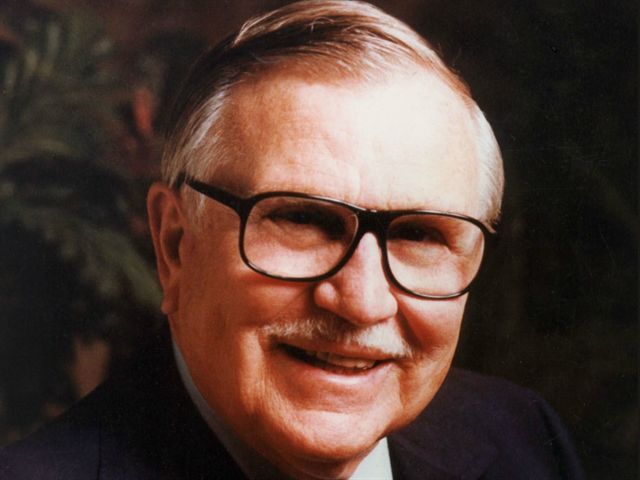
John Vernon McGeewas born in Hillsboro, Texas, in 1904. Dr. McGee remarked, "When I was born and the doctor gave me the customary whack, my mother said that I let out a yell that could be heard on all four borders of Texas!" His Creator well knew that he would need a powerful voice to deliver a powerful message.
After completing his education (including a Th.M. and Th.D. from Dallas Theological Seminary), he and his wife came west, settling in Pasadena, California. Dr. McGee's greatest pastorate was at the historic Church of the Open Door in downtown Los Angeles, where he served from 1949 to 1970.
He began teaching Thru the Bible in 1967. After retiring from the pastorate, he set up radio headquarters in Pasadena, and the radio ministry expanded rapidly. Listeners never seem to tire of Dr. J. Vernon McGee's unique brand of rubber-meets-the-road teaching, or his passion for teaching the whole Word of God.
On the morning of December 1, 1988, Dr. McGee fell asleep in his chair and quietly passed into the presence of his Savior.
Contact Thru the Bible with Dr. J. Vernon McGee
Mailing Address
Thru the Bible, Inc.
P.O. Box 7100
Pasadena, CA 91109
In Canada:
Box 25325,
London, Ontario
N6C 6B1
Phone Number
(626) 795-4145 or
(800) 65-BIBLE (24253)


