Exodus 2:1-21
Ministries > Thru the Bible with Dr. J. Vernon McGee
https://www.oneplace.com/ministries/thru-the-bible-with-j-vernon-mcgee/
Facebook Twitter Instagram YouTubeHumble beginnings often unfold into amazing stories. In Exodus 2, God blessed Jochebed’s sensible faith and saved her child from Pharoah’s soldiers. From a baby in a basket to an Egyptian prince, meet God’s promised deliverer—Moses. Follow along with Dr. McGee as he shows us how God used an imperfect leader to represent Christ and to begin an amazing story of courage, freedom, and redemption for God’s people.
References
Steve Schwetz: Welcome to Thru the Bible. You'll want to fasten your seatbelt and hold on because we're going to be traveling through the ancient land of Egypt, and we'll be going pretty fast. Our teacher is Dr. J. Vernon McGee, and our lesson is in Exodus chapter two. Since we'll be moving so quickly, you may want to hear this study again as it lays the foundation for much of what's going to follow as God prepares Moses to lead his people out of Egypt. Remember, it's available anytime in our app or at ttb.org. Before we get started, Greg and I have a letter to read that I know you're going to love.
Greg: We do. Steve, you often talk about what a joy it'll be to meet people in heaven that we've had a chance to minister to. I can't wait to meet all the prisoners from around the world. We have a wonderful letter from a prisoner right here in the US.
Guest (Male): I want to share my testimony of how the Lord found me when I was lost and broken. Back in 1994, when I was 33 years old, I was sitting in jail. My spirit was crushed under the weight of it all. Everything felt unjust, and I was filled with anger and confusion. One day, a man who himself was facing a long prison sentence came up to me and handed me a Bible. I didn't think much of it at first, but I began to open it to the book of Matthew. There I saw the words, "Lay not up for yourselves treasures on earth." The truth is, I had no schooling. I didn't know how to read or write properly. I tried to read those words, but I couldn't understand them. So I cried out to Father God Almighty and asked Him, "Please help me read Your word." And He did. He opened my eyes. Suddenly, I could understand what I read. Not because of anything I had done, but because of His mercy.
Steve Schwetz: Before I went to jail, I thought I was doing all right in this world. But the truth is, I was living in sin. I was a fornicator, I was an alcoholic, I was a liar. In that jail cell, God showed me something deeper: that I wasn't just condemned in this world, but I was on the path to darkness without Him. Then they placed me in solitary confinement. What felt like punishment became the place where I was truly found. In that silence, God opened my ears. He opened my heart. He showed me His mercy in a way I had never known before. When I was brought back into the general population, something had changed. Other inmates began to come up to me with questions. I didn't have an education. I didn't have all the answers. All I could say was, "He opened my eyes, and I believe." During those years, we were allowed to have radios, and I listened every day to Dr. J. Vernon McGee. For four years I listened and learned, growing in the word. At first, I was still angry, but over time, God showed me something greater. Even in the middle of injustice, He was bringing me to the truth.
Guest (Male): When I was released, I began to witness right away, and I quickly saw how much the truth is hated. Even my own family turned away from me. Today, I have very little in this world, but now I understand why "Lay not up for yourselves treasures upon earth." Those words are no longer just something I read; they're something I live. Because now I know this: I do not fear death. Through the blood of Jesus Christ, the grave has no victory and death has no sting for those who have the love of Christ. I thank God that He found me, even in a jail cell.
Greg: Wow, powerful, powerful stuff. Lord, Your word can penetrate all barriers, and we thank and praise You that it reached this man in the darkness of a prison, even in solitary confinement. We just marvel at Your power, and we ask for You to keep moving powerfully through Your word around the world today, in Jesus' name. Amen.
Steve Schwetz: Here's our study of Exodus two on Thru the Bible with Dr. J. Vernon McGee.
Dr. J. Vernon McGee: Now friends, we come today to the second chapter of the book of Exodus. If you have your Bible, turn there with us because we want to begin right there. It'll make it more meaningful to you. If you have the notes and outlines to follow along with them, and now we find them here in the book of Exodus as we begin it, it just continues the story. There's been a hiatus of about three and a half centuries. There's been this period of three and a half centuries and the people of Israel are now slaves in the land of Egypt. That was according to the way God had predicted it to this man Abraham. This is the way that God had told him. We have brought before us now Moses, the deliverer. In fact, the first 11 chapters here, we have the deliverer. The first chapter was slavery of Israel in Egypt. Now we have in this chapter two, the birth of Moses and the first 40 years in Pharaoh's palace. Then when we get to chapter three, we'll see the call of Moses and his second 40 years in Midian and the incident there at the burning bush. Then we have the return of Moses to Egypt in chapter four and the announcement of the deliverance of Israel. Then the rest of the book deals with that period. We have the deliverance then in chapters 12 through 14 by blood and power. Then we have them marching to Mount Sinai in chapters 15 to 18, and we have the giving of the law in chapters 19 through 24. Then the blueprint and construction of the tabernacle in chapters 25 to 40. I'm just giving you the outline of this very marvelous book of Exodus where nothing is begun, nothing ended, it's just a continuation of the story that was begun in Genesis and we'll follow it when we get into Leviticus and the book of Numbers. This is the great book on redemption, the deliverance of the children of Israel, and we're going to see that. Now I feel like that along with this story, what we need is to have the other accounts concerning Moses, and we'll be filtering them in here from time to time. We have the story of Moses over in the 11th chapter of Hebrews, and frankly this is, shall I say, just a capsule account of the book of Exodus beginning with Moses. That's in Hebrews 11, verse 23. Let me read this and we'll have a background for what we're going to look at. "By faith Moses, when he was born, was hid three months of his parents, because they saw that he was a proper child; and they were not afraid of the king's commandment. By faith Moses, when he was come to years, refused to be called the son of Pharaoh's daughter; choosing rather to suffer affliction with the people of God, than to enjoy the pleasures of sin for a season; esteeming the reproach of Christ greater riches than the treasures in Egypt: for he had respect unto the recompense of the reward. By faith he forsook Egypt, not fearing the wrath of the king: for he endured, as seeing him who is invisible. Through faith he kept the passover, and the sprinkling of blood, lest he that destroyed the firstborn should touch them. By faith they passed through the Red sea as by dry land: which the Egyptians assaying to do were drowned." Now that is the record of Exodus actually, that's put in Hebrews 11 in a rather capsule account. Now we widen it out here in this book, and let me begin reading now with Exodus chapter two, verse one. "And there went a man of the house of Levi, and took to wife a daughter of Levi." That is to me a very wonderful way that Moses gives his own record. He gives a very modest account, and that's one reason I'm turning to these other sections where we have a mention of Moses because he certainly is very humble in the way that he presents it. In other words, I'm sure most of us would want to tell about our father and mother in a great deal of detail. He doesn't even mention them by name. These were just ordinary folk. They were in slavery. They were members of the tribe of Levi, and it's just the same old story we're going to find it again and again in the word of God. That is the old story of a man sees a woman and falls in love with her and tells her so, and she loves him, and they get married and have a child. That's getting right down to the nitty gritty, folk, and that's what human life is all about to tell the truth. That's the story that is here. Later on we're given their name, and I have asked this question of classes and I've also heard it asked on radio years ago when they had these Bible quizzes: who is Amram and Jochebed? And boy, they scratch their heads, folks say, well, never heard of them. Well, that's the name of the man and the woman here of the tribe of Levi, the father and mother of Moses. We'll pick up that name when we get to the sixth chapter. Now will you notice, "And the woman conceived, and bare a son: and when she saw him that he was a goodly child, she hid him three months." Now that's all it said about him, he was a good healthy child. That's all Moses is saying here, and I'm sure that many of us would like to tell about what a precocious child we were when we were little. Most of us feel that way about it, but Moses notice how reticent he is in giving his own record. Verse three: "And when she could not longer hide him, she took for him an ark of bulrushes, and daubed it with slime and with pitch, and put the child therein; and she laid it in the flags by the river's brink." There are several things that we need to comment about here. I think the first thing that's quite evident is that he was not only a good healthy child, he had a good set of lungs, and they could hide him at first, but there came the day when little Moses could really scream at the top of his voice. What a contrast that is to him later on when he pleads to the Lord that he can't speak for the Lord. I'm afraid a great many of us were good at crying as a baby, but we don't do so well today for the Lord. Well, she has to do something about it now. May I say that there are a lot of pious folk today that would have done it different than Jochebed did it. I think that some of these folk today would have said, "Well, we're just going to trust the Lord." May I say that's wonderful to say that, but really do you trust the Lord when you are actually playing the fool? She'd have been foolish to have kept this child in the house there when a guard passing by, one of the slave drivers, why he'd have heard the child. It'd have been absurd. Well, somebody I know would come forth and say, "Well, you know that the child wouldn't cry when the slave driver went by." How do you know? May I say to you, faith is not a leap in the dark as I heard a liberal say years ago. If it's a leap in the dark, don't make the leap, friends. God asks you to believe that which is good and solid, and He's never asked you to do anything foolish when you believe God. You believe God, friends, and not some silly type of circumstance. God expects us to use our good old consecrated gumption. We need a lot of good religious gumption today, and she does a sensible thing. She makes a little ark, and she puts Moses in it. This woman now is acting in a sensible way, and that's an evidence she's trusting God. Now not only that: "And his sister stood afar off, to wit what would be done to him." So she puts the little sister down there. Now again, she could have put him down there and said, "Oh, I trust the Lord. I'll just let him go on." Remember a mother that I talked to about her son years ago? Well, may I say that the boy's been in prison since then. I told her what I thought that she ought to do, and she said, well, she didn't feel like that was trusting the Lord. Well, what she did was very foolish. It wasn't really trusting the Lord. Let's be very careful. This pious nonsense is not trusting the Lord at all. Now, she could put him down there in the bulrushes and said, "Oh, I just leave him there in the hands of the Lord." But she just happened to put Miriam, his sister, his eldest sister, to watch over him down there. "And the daughter of Pharaoh came down to wash herself at the river." This is marvelous to me. Here's where the hand of the Lord now is revealed. The Lord's going to intervene, but you got to be sensible first and she's been sensible. "And her maidens walked along by the river's side; and when she saw the ark among the flags, she sent her maid to fetch it." Now she came down to the Nile river to wash. I have several comments to make there. I went to the place that they say was the place where Moses was put in the bulrushes. Well, my comment is that that would be no place for Pharaoh's daughter to take a bath. She'd be dirtier coming out than she would be going in. That's the first comment. The second is, it sure is a public place. Now I don't think Pharaoh's daughter went to a place like that in that day. They were very uncivilized back then. They didn't believe in nudism as we do today. We are, you know, free and believe in freedom today and expressing ourselves and communicating and opening up our minds and all that nonsense. Back then they were very uncivilized as you can see. So I'm sure that it was a much more secluded spot than was shown me. But anyway, the important thing here is that God's overruling now. You see God can intervene, and it's very well that Miriam, the sister of Moses, was there. "And when she had opened it, she saw the child: and, behold, the babe wept." And at that moment, it was the right time for the child to cry. In fact, at that very moment, the Lord pinched little Moses and he let out a yelp. God brought together two things, I tell you friends, that He's put together in this world. One is a baby's cry and a woman's heart. Pharaoh's daughter there just couldn't pass it by, and she had compassion on him and said, "This is one of the Hebrews' children." Then said his sister, and she's right there to make the suggestion to Pharaoh's daughter, "Shall I go and call to thee a nurse of the Hebrew women, that she may nurse the child for thee?" That was a very helpful suggestion of Miriam. By the way, Miriam is not going to let her young brother Moses forget that later on, by the way. You see this is a very human story we are reading. Let's get real when we read the Bible, friends, of all this pious nonsense and get down to the nitty gritty and find out what God's really trying to tell us today because I think He's speaking to us on every page of this book. Now will you notice, "And Pharaoh's daughter said to her, Go." It was a good suggestion. "And the maid went and called the child's mother." My friend, this is a real turn of events, and it shows how God really moves when we act sensibly and move by faith sensibly. Now the very mother of the child is called to nurse her own baby and's going to be paid for it. You can't beat that friends, and you can't beat God when He is really moving in our hearts and lives. Now notice this: "And Pharaoh's daughter said unto her, Take this child away, and nurse it for me, and I will give thee thy wages. And the woman took the child, and nursed it. And the child grew, and she brought him unto Pharaoh's daughter, and he became her son." Now don't let that go by because that is very meaningful and includes a great deal. "And she called his name Moses: and she said, Because I drew him out of the water." The word means "to draw out." She had drawn him out of the water, and that was the meaning of his name. Now this is very important for us to see, and I must take just a moment here to dwell on this. He spent 40 years yonder in the court of Pharaoh, and he was the adopted son of Pharaoh's daughter. At that time, by the way, there was a queen that was childless, and Moses would have been the next Pharaoh, by the way. Notice this, verse 11: "And it came to pass in those days, when Moses was grown, that he went out unto his brethren, and looked on their burdens: and he spied an Egyptian smiting a Hebrew, one of his brethren." Now we're going to look at that in just a moment, but what I'm trying to do is cover these first 40 years of the life of Moses. Now he spent them in the court of Pharaoh and he was being raised there. Several things I'd like to say about that period that must have been true. He was trained in Egypt so much so that he looked like an Egyptian, talked like an Egyptian, acted like an Egyptian, and he was recognized as that when he went to Midian, as we shall see. Now obviously he was educated in the Temple of the Sun, the great university of that day. This Temple of the Sun was a great university, although it didn't prepare him to serve God. There's a great deal that can be said about that Temple of the Sun. We underrate the Egyptians in what they knew and what they did. First of all, let me say that this university and Egyptians knew a great deal more than we give them credit for. For instance, they knew the exact distance to the sun. Their astronomy is phenomenal what they knew about the universe that we live in. They did not take the position as scientists did later on that the earth was flat. They didn't work on that theory at all. It's quite interesting, these Egyptians had a real knowledge, and they also knew a great deal about chemistry. That's evident from their fact the way that they embalmed the dead. We have no process like that today at all. Also, their coloring. Now I looked at some of the colors when I was in the museum in Cairo. I spent a little time in there, and if I ever go back to Cairo, the only reason I'd ever want to go back would be to go to that museum. They have a wealth of material. The thing that impressed me was the workmanship, was the coloring. Why those colors are brighter today than any colors that we have. So much so that very candidly, I'm confident many of these paint companies, Sherwin-Williams Paint Company, give anything in the world they knew the formula that they used back in those days for colors. They're bright and beautiful and startling and clear. And that's after about 4,000 years. I have to paint my house about every four years. I wish I could get some of the paint that they used back in those days. These people knew a great deal. They had a library that was tremendous. And so this man Moses, we are told, was learned in all the wisdom of the Egyptians. That's the thing that you remember Stephen said. I'd like to turn to that, by the way, over in the seventh chapter of Acts at verse 22. Listen to this: "And Moses was learned in all the wisdom of the Egyptians, and was mighty in words and in deeds." Don't underestimate Moses, friends. He was outstanding, and he was mighty in words and deeds. "And when he was full forty years old, it came into his heart to visit his brethren the children of Israel. For he supposed his brethren would have understood how that God by his hand would deliver them; but they understood not." In other words, all the training in Egypt did not prepare him to deliver the children of Israel. So he went out, and when he saw one of his brethren being persecuted or being beaten by one of the slave drivers, why he killed him. He looked this way and that way; trouble of it is he didn't look up. That's where he should have looked to God, and the Lord would have forbidden him to do a thing like this because Moses is 40 years ahead of God in delivering the children of Israel. Therefore, God now is going to put him out on the back side of the desert. "And when he went out the second day, behold, two men of the Hebrews strove together: and he said to him that did the wrong, Wherefore smitest thou thy fellow? And he said, Who made thee a prince and a judge over us? intendest thou to kill me, as thou killedst the Egyptian? And Moses feared, and said, Surely this thing is known. Now when Pharaoh heard this thing, he sought to slay Moses." In other words, Moses was a murderer. "But Moses fled from the face of Pharaoh, and dwelt in the land of Midian: and he sat down by a well." Now he spent 40 years in Egypt, and that training did not prepare him for what was to come. "Now the priest of Midian had seven daughters: and they came and drew water, and filled the troughs to water their father's flock. And the shepherds came and drove them away: but Moses stood up and helped them, and watered their flock. And when they came to Reuel their father, he said, How is it that ye are come so soon today? And they said, An Egyptian..." You see, Moses passed as an Egyptian. He certainly had the background for it. "An Egyptian delivered us out of the hand of the shepherds, and also drew water enough for us, and watered the flock. And he said unto his daughters, And where is he? why is it that ye have left the man? call him, that he may eat bread." And Moses was content to dwell with the man: and he gave Moses Zipporah his daughter. Now she is given to Moses, and he takes a bride. It's interesting, many of the men of the Old Testament are figures of Christ, not in all detail, they couldn't be. Certainly not in the fact Moses was a murderer, Christ was not. He was a savior. And Jonah is a figure of Christ in resurrection, but certainly not in running away from God. And so Moses here in the time of his rejection, why he gets a bride. And we are living in the day of the rejection of Christ, but He's calling out a bride out of this world today, and that's the church. So we find him now down in the land of Midian, and 40 years goes by. So next time I want us to look at what to me is one of the greatest truths concerning our redemption. That is, God says He's ready to deliver Israel, and on what basis will God deliver them? Well, it's the same basis that He'll deliver and save you and me today. I trust that you will be with us for the broadcast next time. May God richly bless you, my beloved.
Steve Schwetz: Well, that's a great teaser for our next study. Until then, to get the notes and outlines that Dr. McGee mentioned, just download our app or visit ttb.org or call 1-800-65-BIBLE if we can help. I'm Steve Schwetz, and I'll meet you back here as the Bible bus rolls along.
Choir: Jesus paid it all, all to Him I owe. Sin had left a crimson stain, He washed it white as snow.
Steve Schwetz: Our journey on the Bible bus today is supported by the prayers and gifts of fellow passengers as we travel through the Bible.
Related Episodes
Exodus 1
Thursday, August 27
Matthew 27:50—28:20
Wednesday, August 26
Matthew 27:1-50
Tuesday, August 25
About Thru the Bible
Thru the Bible takes the listener through the entire Bible in just five years, threading back and forth between the Old and New Testaments. You can begin the study at any time. When we have concluded Revelation, we will start over again in Genesis, so if you are with us for five years you will not miss any part of the Bible.
Other Thru the Bible Programs:
Thru the Bible - Minute with McGee
Thru the Bible - Questions & Answers
Thru the Bible - Sunday Sermon
About Dr. J. Vernon McGee
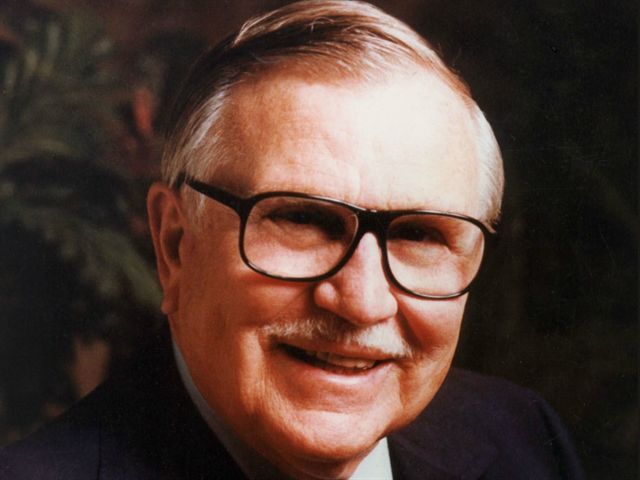
John Vernon McGeewas born in Hillsboro, Texas, in 1904. Dr. McGee remarked, "When I was born and the doctor gave me the customary whack, my mother said that I let out a yell that could be heard on all four borders of Texas!" His Creator well knew that he would need a powerful voice to deliver a powerful message.
After completing his education (including a Th.M. and Th.D. from Dallas Theological Seminary), he and his wife came west, settling in Pasadena, California. Dr. McGee's greatest pastorate was at the historic Church of the Open Door in downtown Los Angeles, where he served from 1949 to 1970.
He began teaching Thru the Bible in 1967. After retiring from the pastorate, he set up radio headquarters in Pasadena, and the radio ministry expanded rapidly. Listeners never seem to tire of Dr. J. Vernon McGee's unique brand of rubber-meets-the-road teaching, or his passion for teaching the whole Word of God.
On the morning of December 1, 1988, Dr. McGee fell asleep in his chair and quietly passed into the presence of his Savior.
Contact Thru the Bible with Dr. J. Vernon McGee
Mailing Address
Thru the Bible, Inc.
P.O. Box 7100
Pasadena, CA 91109
In Canada:
Box 25325,
London, Ontario
N6C 6B1
Phone Number
(626) 795-4145 or
(800) 65-BIBLE (24253)


